
Events
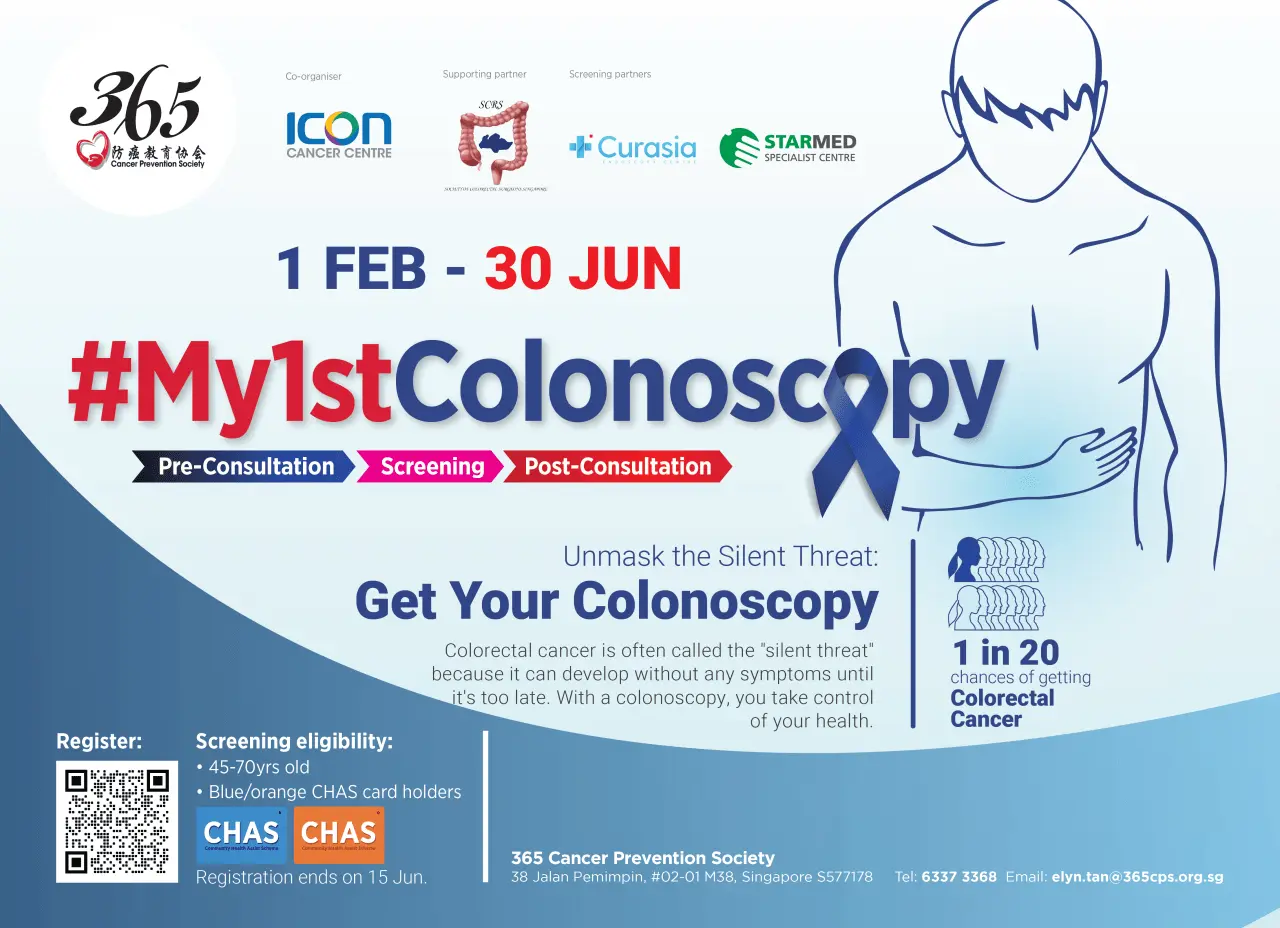
Colorectal cancer ranks as one of Singapore’s top two cancer affecting men and women. With about 1,500 newly diagnosed cases of Colorectal cancer in Singapore each year, the risk of a person getting colorectal cancer during his lifetime is 5.6%.
Despite its high treatability and durability with early detection and treatment, many individuals aged 50 years and above, especially those from low-income backgrounds, are unable to undergo colonoscopy due to concerns about costly expenses and complicated procedures.
#My1stColonoscopy is a campaign jointly organised by Icon Cancer Centre and 365 Cancer Prevention Society to provide seamless access to sponsored colonoscopy for individuals aged 45 to 70 from lower-income families. The sponsored colonoscopy includes pre-screen and post-screen consultation with a specialist. By offering this initiative, the campaign aims to ensure that individuals who might otherwise be unable to afford or access colonoscopies can benefit from early detection and treatment of colorectal cancer.
Screening Eligibility Criteria:
- 45 to 70 years old
- Valid blue/orange CHAS card
Exclusion Criteria
Please do not register if you:
- had done a colonoscopy procedure within the last 5 years
- are unable to provide informed consent and require caregiver translation or interpretation
- require wheelchair assistance of mobility devices
- have medical conditions such as: on a pacemaker, on blood thinners (e.g. aspirin or anti-coagulants), recent hospital admission within last 6 months
Kindly note that all well-controlled conditions such as hypertension, diabetes mellitus, hypercholesterolemia, asthma, are suitable for this procedure. Please declare if you have any such conditions upon registration.
Do follow us on Telegram or Facebook (365 Cancer Prevention Society) to stay updated on our screening campaigns.
About Colorectal Cancer
The term Colorectal Cancer refers to the cancer of parts of the large gut. i.e., either the colon or rectum. The colon and rectum make up the majority of the large gut. This cancer is most often characterized by the uncontrolled growth of the cells of the large gut lining known as epithelial cells.
Colorectal cancer is strongly linked to family history as well as other gastrointestinal disorders of the large gut such as colonic polyps. Polyps are the outgrowth in the inner lining of the large gut. In fact, most colorectal cancers start as polyps which then acquire the ability to divide indefinitely.
Colorectal cancer may grow outward into the wall of the gut and involve the outer layers from which it can spread to blood vessels or lymph nodes and ultimately to the other parts of the body.
Signs and Symptoms
Colorectal cancer in its early stages may be undetected due to being silent (having no symptoms at all) although there are certain alarming signs of colorectal cancer. These include:
- Blood in your stools
- Change in bowel habits
- Abdominal pain or discomfort
- Anaemia (a low red blood cell count)
- Presence of a lump in the abdomen
Causes and Risk Factors
- Age – Men and women aged 50 years and above have an increased risk of colorectal cancer.
- Ethnicity – Among the races in Singapore, the Chinese have a higher risk of colorectal cancer.
- Personal History
- Family History
- Ulcerative Colitis
- Drugs
- Sedentary lifestyle and obesity
- Dietary Habits
How to prevent Colorectal Cancer?
Some of the preventive measures against the development of colorectal cancer are:
- Screening for colorectal cancer – Regular screening can decrease the risk of the development of colorectal cancer. Polyps if found, can be removed if indicated to prevent their transformation into malignant masses. Patients should have a colonoscopy every 10 years starting at the age of 50 years as routine screening. Those having a familial history of colorectal cancer or polyposis may start screening 10 years earlier than the age at which their family member developed the disease or the age of 40 years, whichever comes earlier.
- Dietary measures – Diets having a high content of fruits, vegetables, and whole grains are linked with prevention against the development of colorectal cancer.
- Regular physical activity – Increased physical activity has been linked to a lower risk of colorectal cancer and polyps while limiting the sitting time as well as time lying down also helps in prevention.
- Limiting alcohol intake – Several studies have found an increased incidence of colorectal cancer with increased alcohol intake.
- Maintain Bodyweight at healthy levels.
- Cessation of smoking.
- Taking multivitamins – Some studies suggest a reduced incidence of colorectal cancer with regular intake of multivitamins, calcium and magnesium.
Screening Process
Step 1 – Register with 365CPS
Submit your registration form. Upon submission, our staff will respond to you in 5 working days.
If eligible, you will receive a Confirmation Letter endorsed by 365CPS.
Please note that a $50 refundable deposit will be collected at the point of registration.

Step 2 – Pre-Screen Consultation
Contact your preferred clinic to book your appointment.
Consultation Hours: Monday to Friday, 8.00am to 5.00pm
Please bring your NRIC and Confirmation Letter for your appointment.

Step 3 – Colonoscopy
For applicants who are eligible for the sponsored colonoscopy, the clinic will book an appointment for your colonoscopy procedure performed by surgeons from the Society of Colorectal Surgeons (Singapore).
The doctor will guide and prepare you for the procedure.
Step 4 – Review after Colonoscopy
The clinic will arrange for a review after the colonoscopy procedure before you are discharged from the facility.
If further investigations are required, a referral letter will be issued to you to refer you to a public health setting.